
CPU and GPU are two important components of a computer system. Both are used to process data and perform calculations, but their working methods and purposes are different.
The CPU is known as the Central Processing Unit, while GPU stands for Graphics Processing Unit. The CPU handles general computer operations, such as running programs, managing operating systems and performing calculations. On the other hand, the GPU is specially designed to process graphics, images, videos and perform many calculations simultaneously.
In this article, we will explain the difference between CPU and GPU, their functions, features, advantages, disadvantages and uses in simple language.
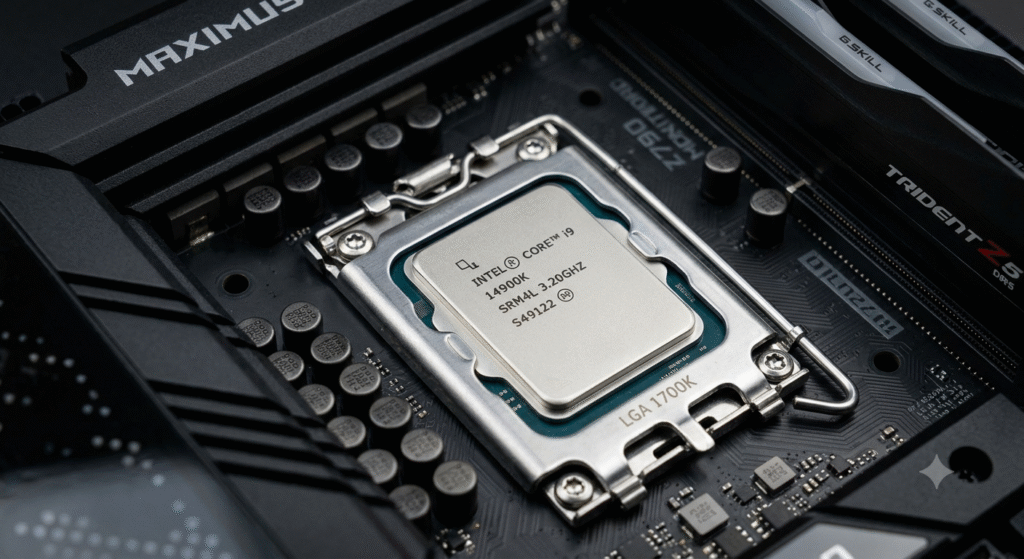
1. What is CPU (Central Processing Unit)?
CPU stands for Central Processing Unit. It is also known as the brain of the computer because it controls and manages most of the operations performed by a computer system.
The CPU receives instructions from computer programs, processes data and provides the required output.
For example, when you open a web browser, type a document, calculate numbers or run software, the CPU performs the instructions required for these activities.
Main Functions of CPU:
- Executes instructions provided by computer programs.
- Performs arithmetic calculations such as addition, subtraction, multiplication and division.
- Performs logical operations and comparisons.
- Controls and manages other computer components.
- Runs the operating system and application software.
- Manages data processing and system operations.
- Coordinates communication between different hardware components.
Examples of CPU: Intel Core i3, Intel Core i5, Intel Core i7, Intel Core i9 and AMD Ryzen processors
Advantages of CPU
- Performs general-purpose computing tasks.
- Handles complex instructions efficiently.
- Controls and manages computer operations.
- Supports operating systems and application software.
- Performs logical and arithmetic calculations.
- Provides flexibility for different types of workloads.
Disadvantages of CPU
- It is less efficient than a GPU for many highly parallel tasks.
- It may take more time to process large graphics workloads.
- High-performance CPUs can be expensive.
- Complex processing can generate heat.
- It is not specially designed for advanced graphics rendering.

2. What is GPU (Graphics Processing Unit)?
GPU stands for Graphics Processing Unit. It is a specialized processor designed to handle graphics-related operations and perform multiple calculations simultaneously.
The GPU is mainly used for displaying images, playing videos, running games, video editing, 3D animation and artificial intelligence applications.
For example, when you play a high-quality 3D game, the GPU processes graphics, textures, lighting and visual effects to display smooth images on the monitor.
Main Functions of GPU:
- Processes images, videos and graphics.
- Renders 2D and 3D graphics.
- Helps run high-quality computer games.
- Supports video editing and animation.
- Performs parallel calculations.
- Helps in Artificial Intelligence (AI) and Machine Learning.
- Supports scientific simulations and complex computing tasks.
Examples of GPU: NVIDIA GeForce RTX, AMD Radeon RX and Intel Arc Graphics.
Advantages of GPU
- Performs many calculations simultaneously.
- Provides high-quality graphics processing.
- Improves gaming performance.
- Supports video editing and 3D rendering.
- Helps in Artificial Intelligence and Machine Learning.
- Processes large amounts of parallel data efficiently.
Disadvantages of GPU
- Dedicated GPUs can be expensive.
- High-performance GPUs may consume more electricity.
- They can generate considerable heat.
- They are not as efficient as CPUs for every type of task.
- Some GPUs require additional cooling and power supply.
3. Difference Between CPU and GPU
The CPU and GPU are both processors, but they are designed for different types of tasks.
| Feature | CPU (Central Processing Unit) | GPU (Graphics Processing Unit) |
|---|---|---|
| Full Form | Central Processing Unit | Graphics Processing Unit |
| Role / Nickname | Brain of the computer | Graphics processor |
| Design Purpose | General-purpose processing | Graphics and parallel processing |
| Core Architecture | Fewer powerful cores | Many smaller processing cores |
| Processing Style | Handles tasks one after another efficiently, as well as multiple tasks | Performs many similar calculations simultaneously |
| Overall Management | Manages the overall computer system and operating systems | Mainly handles graphics and parallel computing tasks |
| Operations Suitability | Suitable for complex logical operations | Suitable for repetitive mathematical operations |
| Memory | Large cache memory | High-bandwidth graphics memory in many designs |
| Importance | Essential for running general applications and system instructions | Important for gaming and graphics-intensive applications |
| Optimization | Optimized for low-latency processing | Optimized for high-throughput processing |
| Primary Use Cases | General computing and essential computer operations | Gaming, AI, video processing, and parallel tasks |
| Examples | Intel Core and AMD Ryzen | NVIDIA GeForce and AMD Radeon |
Uses of CPU and GPU
| CPU Uses | GPU Uses |
|---|---|
| Running Windows and Linux | Playing computer games |
| Running MS Word and Excel | Video editing |
| Internet browsing | 3D animation |
| Running computer software | Graphics designing |
| Programming | Artificial Intelligence |
| Database management | Machine Learning |
| Managing computer operations | Scientific simulations |
| Performing calculations | Image and video processing |

Frequently Asked Questions (FAQs)
Q1. What is the full form of CPU?
CPU stands for Central Processing Unit. It is the main processor responsible for executing instructions and managing computer operations.
Q2. What is the full form of GPU?
GPU stands for Graphics Processing Unit. It is a specialized processor used for graphics rendering and parallel processing.
Q3. What is the main difference between CPU and GPU?
The CPU is designed for general-purpose processing, whereas the GPU is designed for graphics processing and performing multiple calculations simultaneously.
Q4. Which is faster, CPU or GPU?
A GPU is generally faster for highly parallel tasks, while a CPU is better suited for many general-purpose and sequential processing tasks.
Q5. Is GPU necessary for a computer?
A dedicated GPU is not necessary for basic computer work. Integrated graphics can handle everyday activities such as browsing, typing and watching videos.
Q6. Can CPU and GPU work together?
Yes, CPU and GPU work together to perform different computing tasks and improve overall system performance.
Q7. Which is better for gaming, CPU or GPU?
Both are important for gaming. The CPU handles game logic and other calculations, while the GPU processes graphics and visual effects.
Q8. What is VRAM in GPU?
VRAM stands for Video Random Access Memory. It is memory used by a graphics card to store graphics data, textures, images and other visual information.
Q9. Give two examples of CPU and GPU.
CPU examples: Intel Core i5 and AMD Ryzen 5. GPU examples: NVIDIA GeForce RTX and AMD Radeon RX.
Q10. Why is GPU important in Artificial Intelligence?
GPU can perform many mathematical calculations simultaneously, making it useful for training and running many Artificial Intelligence and Machine Learning models.
Excellent!