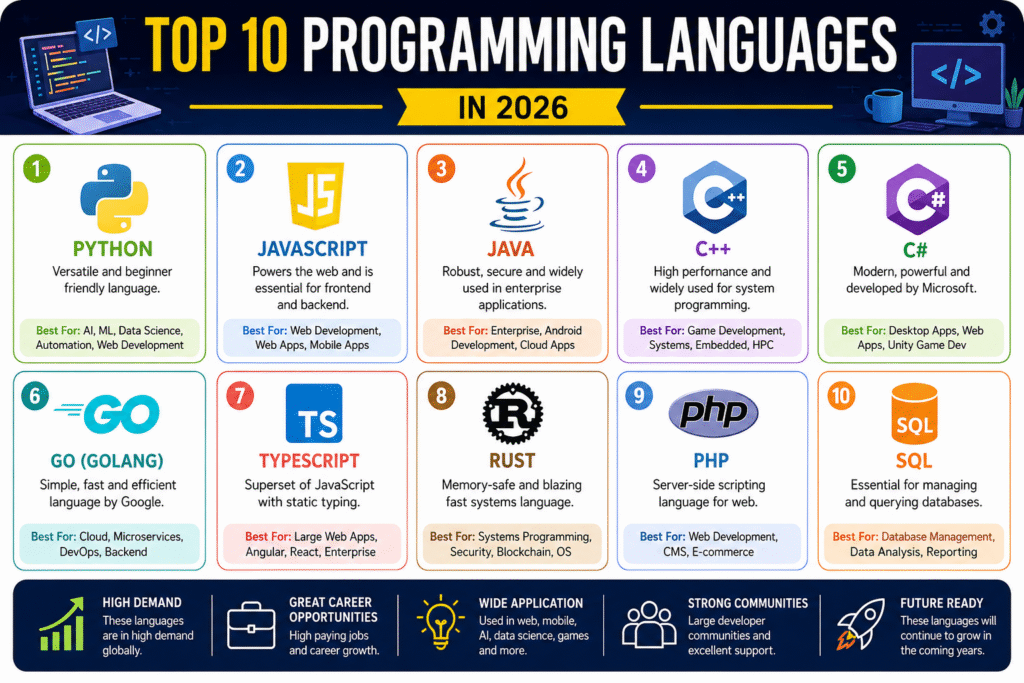
Programming languages are the foundation of software development. Whether you're building websites, mobile apps, artificial intelligence (AI) systems, games, or enterprise software, choosing the right programming language can significantly impact your career.
With technology evolving rapidly, many beginners ask:
This comprehensive guide answers all these questions by exploring the Top 10 Programming Languages in 2026 based on industry demand, popularity, community support, and future growth. Python continues to dominate many popularity indices thanks to AI, automation, and data science, while JavaScript remains indispensable for web development.
1. Python
Overview
Python is the world's most popular programming language because of its simplicity and versatility. It is widely used in Artificial Intelligence, Machine Learning, Data Science, Automation, Web Development, and Cybersecurity.
Key Features
Best For
Companies Using Python
2. JavaScript
JavaScript powers almost every modern website. It is the only programming language that runs directly inside web browsers.
Key Features
Best For
Companies Using Python
3. Java
C++ remains one of the fastest programming languages available.
Key Features
Advantages
Companies Using Python
4. C++
Java has been an industry standard for over two decades.
Best For
Advantages
Companies Using Python
5. C#
Developed by Microsoft, C# is popular for Windows applications and game development.
Best For
Framework
.NET
6. Go (Golang)
Go was created by Google to build scalable cloud applications.
Advantages
Used In
7. TypeScript
TypeScript is JavaScript with static typing.
Large companies prefer TypeScript because it reduces coding errors and improves maintainability.
Best For
8. Rust
Rust has become increasingly popular because of its focus on memory safety and performance. It continues to rise in industry rankings as organizations prioritize secure systems software.
Best For
Advantages
9. PHP
PHP still powers millions of websites worldwide.
Best For
Popular Platforms
10. SQL
SQL is essential for managing databases and remains one of the most valuable skills for developers and data professionals.
Best For
Popular Databases
Comparison Table
| Language | Difficulty | Best For | Job Demand |
|---|---|---|---|
| Python | Easy | AI, ML, Data Science | ⭐⭐⭐⭐⭐ |
| JavaScript | Easy | Web Development | ⭐⭐⭐⭐⭐ |
| Java | Medium | Enterprise Applications | ⭐⭐⭐⭐⭐ |
| C++ | Hard | Game Development | ⭐⭐⭐⭐ |
| C# | Medium | Windows & Unity | ⭐⭐⭐⭐ |
| Go | Medium | Cloud Computing | ⭐⭐⭐⭐ |
| TypeScript | Medium | Large Web Apps | ⭐⭐⭐⭐ |
| Rust | Hard | Systems Programming | ⭐⭐⭐⭐ |
| PHP | Easy | Web Development | ⭐⭐⭐ |
| SQL | Easy | Databases | ⭐⭐⭐⭐⭐ |
Frequently Asked Questions
Which programming language is easiest to learn?
Python.
Which language is best for web development?
JavaScript.
Which language is best for AI?
Python.
Rust and Go often command premium salaries in specialized roles, though compensation depends on region, experience, and industry.
Which language is best for Android development?
Java and Kotlin.
Final Thoughts
The best programming language depends on your career goals rather than popularity alone. If you want to work in AI, start with Python. For web development, JavaScript and TypeScript are excellent choices. For enterprise software, Java remains a reliable option, while Go and Rust are increasingly valuable for cloud infrastructure and systems programming.
No matter which language you choose, consistent practice and building real-world projects will have a greater impact on your career than learning multiple languages without hands-on experience.